
The Tweet That Started This
I saw a tweet ranking top trainers by raw win percentage heading into this year's Kentucky Derby. It made me sad.
It's 2026. We can do so much better.
Here are the numbers we should actually be looking at.
The Sample Size Problem
We've discussed this before. Baffert has run 83 races so far this calendar year. Steve Asmussen has run 680 (680!). Saffie Joseph has run 280. Chad Brown, 173. If you compare their raw win percentages side by side, you're not comparing skill — you're comparing apples to evidence.
A percentage is a ratio. The math doesn't know how many attempts there were — and that matters enormously.
Once we apply Bayesian smoothing to account for sample size, the picture shifts. The result is a much more honest ranking:
| Trainer | Starts | Smoothed Win% | Smoothed ITM% |
|---|---|---|---|
| Brad Cox | 335 | 27% | 58% |
| Bob Baffert | 83 | 25% | 57% |
| Chad Brown | 173 | 22% | 56% |
| Saffie Joseph, Jr. | 280 | 21% | 52% |
| Todd Pletcher | 202 | 18% | 45% |
| Bill Mott | 199 | 18% | 46% |
| Brendan Walsh | 230 | 17% | 46% |
| Steve Asmussen | 680 | 17% | 44% |
| Mark Casse | 317 | 16% | 46% |
Smoothed win% and ITM% — 2026 to date. Samples are adjusted according to the evidence.
Already so much better. Baffert's impressive results over 83 starts get appropriately discounted next to Cox's performances across a much larger sample. The smoothing is doing exactly what a sharp handicapper's instincts should do.
Controlling for Field Size: Wins Above Random
Sample size is one thing. But there's another distortion hiding in plain sight: field size. Winning a 5-horse race is not the same as winning a 12-horse race. Raw win percentage doesn't know the difference.
This is where Wins Above Random (WAR) comes in — yes, we borrowed from baseball, sorry. The concept is (hopefully) simple:
How to Think About WAR
In a 5-horse race where you know nothing about the entries, every horse gets a 20% chance of winning. That's perfectly random. Now I tell you Brad Cox trains one of those horses.
Cox has a WAR per start of 13.5 in 2026. So his horse shouldn't be priced at 20% — it should be priced at:
That 13.5% comes out of the field. The other four horses drop from 20% to roughly 16.6% each. That's the edge the trainer name is worth — measured honestly, against the baseline of randomness.
When we rank trainers by WAR per start and ITMAR per start (in the money above random), something interesting happens: Cox and Chad Brown leapfrog Baffert. And when you look at ITMAR specifically, Baffert falls even further:
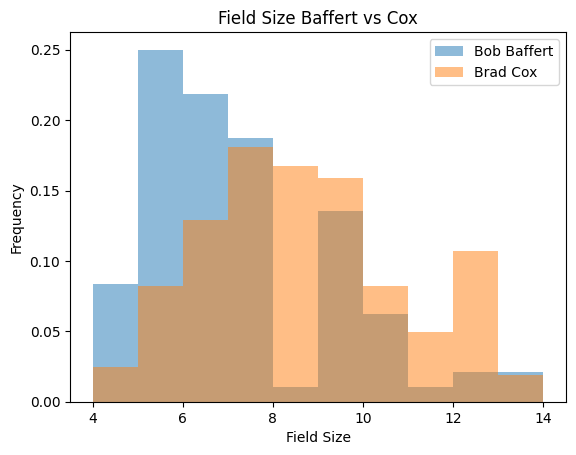
Cox, Brown, Saffie Joseph, Mark Casse, and Brendan Walsh all jump Baffert on ITMAR per start. Baffert doesn't crack the top 50. His in-the-money percentage has been artificially boosted by smaller fields — a distortion that raw stats are completely blind to.
What This Still Doesn't Tell Us
These numbers are better. They're more honest. But they don't tell the whole story, and pretending otherwise would be its own kind of bad analysis.
- Maybe we should only consider stakes races — graded company is a different game than maiden claimers.
- Maybe Brad Cox just gets the best horses. Would you or I win at the same rate with his barn? Possibly.
- Surface splits, distance splits, track-specific performance — none of that is captured here.
We have more questions than answers. But we need to start somewhere, and these numbers are a genuinely better foundation than raw win percentage alone.
The Verdict
The next time you see a stat about win percentage or in-the-money percentage, ask two questions before you trust it:
- Does it account for sample size? If not, small samples are being treated as gospel.
- Does it account for field size? If not, small-field wins are inflating the number.
If the answer to either is no, I'm not trusting it. I'm trusting the data — and the data is clear:
Best Trainer 2026
Brad Cox
And it's not particularly close.
So if you're riding the hot trainer hand into this year's Kentucky Derby, now you know whose hand that actually is.
Comments
No comments yet. Be the first to share your thoughts.
Have thoughts? Sign in to comment.