
Baseball has expected batting average (xBA). Soccer has expected goals (xG). And now horse racing has entered the conversation.
Introducing xPurse.
What Is xPurse?
xPurse — short for expected purse — asks a simple but powerful question: given what we knew before a race, how much purse money should each horse be expected to earn?
The calculation works in two steps. First, it uses DeepOutcomes to estimate each horse's probability of finishing in every position — first, second, third, and so on. Then those probabilities are multiplied by the purse distribution for each finishing position.
Add it all up, and you get a single number: the expected purse for that horse in that race.
That raises an obvious question: why ignore what actually happened?
The Signal and the Noise
Horse racing is saturated with randomness. Trip trouble, pace dynamics, weather, field size, and small sample sizes all introduce variance that can overwhelm true ability in the short run.
As a result, raw purse earnings are a noisy signal. A horse that belongs at the $100,000 level might look like a $40,000 horse after a few unlucky trips — or a $200,000 horse after catching a favorable sequence of races.
xPurse smooths this out. Because it is grounded in probabilities across every start, it accumulates signal more cleanly than realized outcomes. Lucky wins don't inflate it. Unlucky losses don't crush it.
Over time, xPurse begins to reflect underlying ability more reliably than raw earnings.
The Correlation Data
This isn't just theoretical. When xPurse is compared to actual earnings, the relationship is extremely strong.
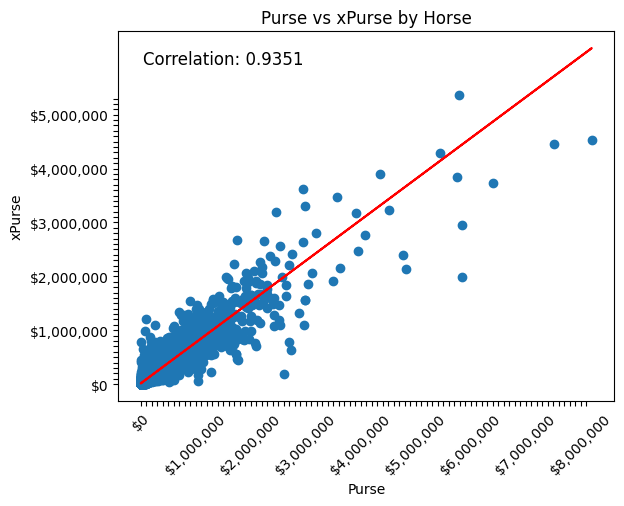
At the horse level, the correlation between total purse and total xPurse is 0.9351. There's noise — as expected — but the signal is clear.
At the trainer level, the correlation rises to 0.9991 — effectively perfect.
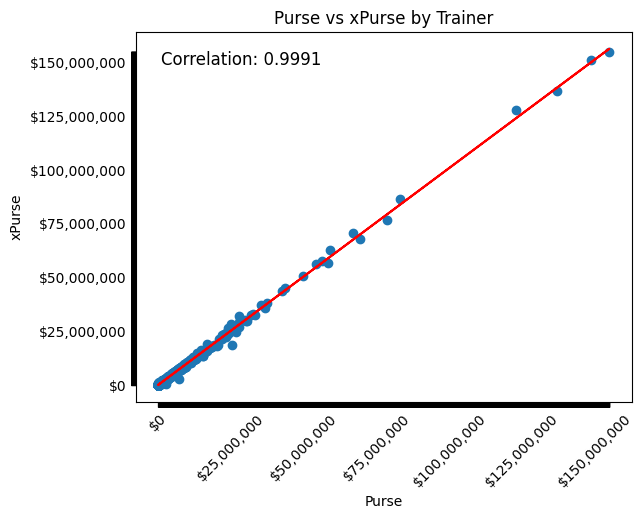
This is exactly what you'd expect. Individual horses experience variance. Trainers, running many horses across many races, see that variance average out.
The takeaway is simple: xPurse is tracking something real — the same underlying signal as earnings, but with less noise.
Example: 2025 Iroquois Stakes
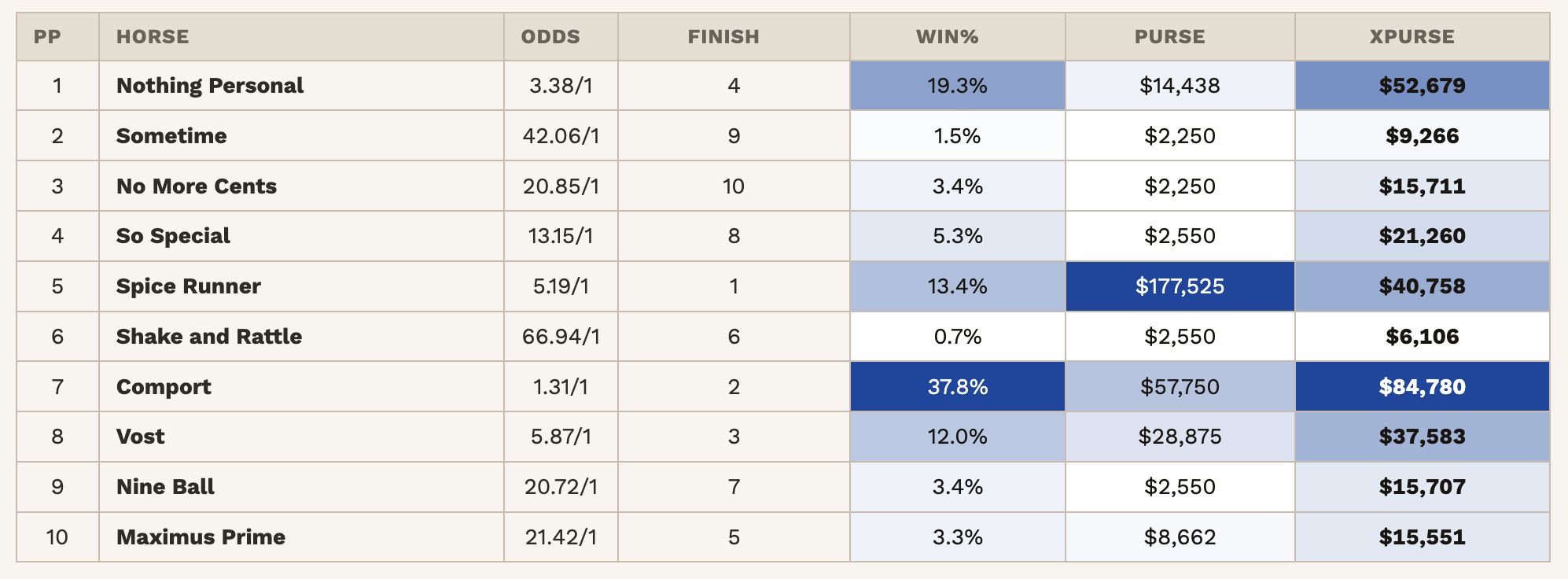
In the Iroquois Stakes, Comport went off as the favorite at roughly 3/2 (after removing takeout). Feeding those probabilities into DeepOutcomes gives us a full finishing distribution — and an xPurse of about $84,000.
Meanwhile, longshot Shake and Rattle carries the lowest xPurse in the field.
But the race itself didn't follow the script:
- The favorite didn't win
- The longshot didn't finish last
If markets and outcomes aligned perfectly, the visualization would line up cleanly. Instead, we see the natural randomness of racing — with Spice Runner winning and capturing the largest purse share.
What Comes Next
Right now, xPurse is primarily a tool for organizing information more clearly. But its implications go further.
Could cumulative xPurse outperform raw earnings as a predictor of future performance? Could it improve morning lines or feed back into models like DeepOutcomes? What happens when you break it down by surface, distance, or class?
It may also help identify horses running above or below their true level — especially in claiming races, where mispricing is the entire game.
Racing has always been a mix of art and data. xPurse doesn't replace the art — but it sharpens the data.
And sometimes, a sharper instrument is enough to start seeing what was always there.
This is just the beginning.
Comments
No comments yet. Be the first to share your thoughts.
Have thoughts? Sign in to comment.